Generate and receive
The diagnostic instrument produces a result. Local LIS software receives it and creates its usual HL7 or ASTM laboratory message.

LSCA carries authorized data from compatible laboratory software over a protected connection to central middleware, where results can be processed, stored and made available to approved systems.
Explore the data flowLSCA securely transports authorized HL7, ASTM and FHIR laboratory communications from compatible instruments and LIS software to central middleware using TLS 1.3 encryption and certificate-based authentication.
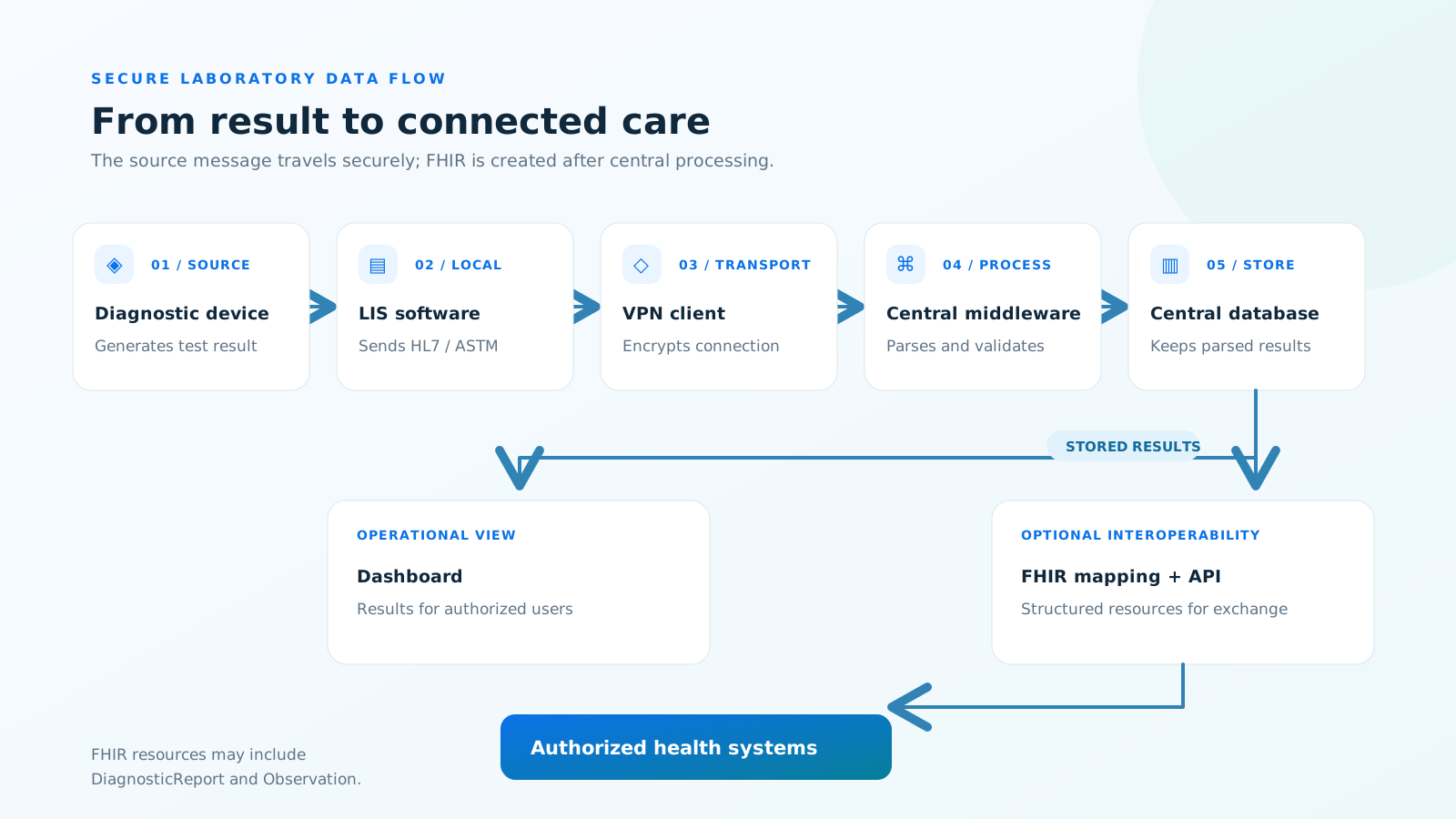
The diagnostic instrument produces a result. Local LIS software receives it and creates its usual HL7 or ASTM laboratory message.
The LSCA client identifies configured laboratory traffic and protects it using TLS 1.3 and certificate-based authentication.
Authorized traffic is carried through the encrypted channel to the designated central middleware. Unrelated traffic is not transmitted through the channel.
The central middleware interprets and stores the message. Authorized users can view the result, and optional APIs can share mapped data with other approved systems.
Recognizes authorized laboratory traffic and securely carries the original HL7 or ASTM message to the configured central endpoint.
Receives and parses laboratory messages, validates the relevant information and stores structured results for operational use.
Maps stored data into supported FHIR resources and shares it through an authorized API when required.
The central administration panel provides visibility and control across deployed LSCA clients.
Register and identify each authorized laboratory site, workstation or connected instrument.
Monitor certificate status and prevent clients with invalid or revoked credentials from establishing a connection.
Review connection health, client status and relevant communication or security events.
Tell us what your LIS produces and where your laboratory results need to go.
Prefer email? Contact support@lsca.online